
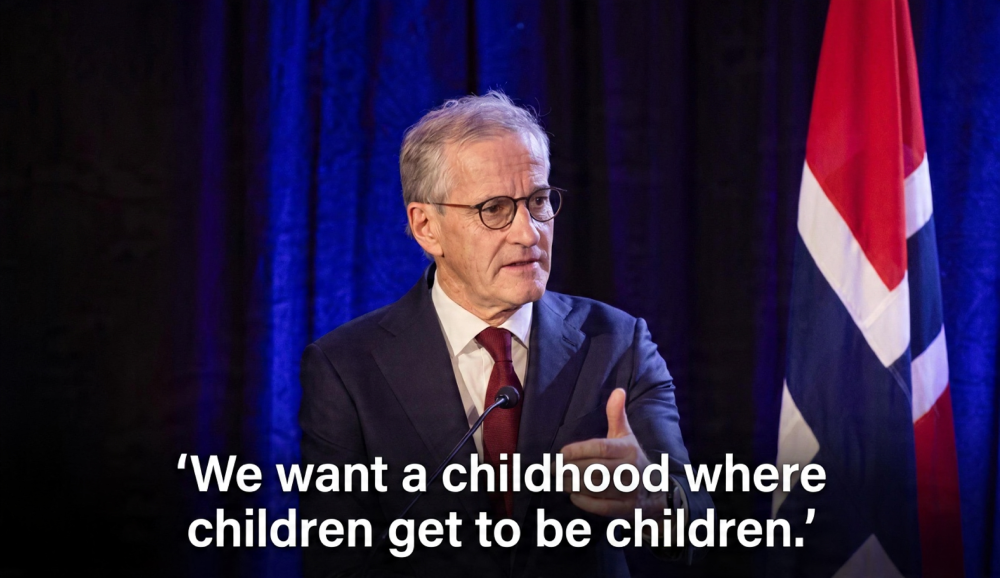
Norway has become the latest country to announce plans for a legislative ban on social media for children under the age of 16.
The announcement, made by Prime Minister Jonas Gahr Støre, signals a growing global consensus that “algorithms and screens” are taking over childhood.
In a press conference that has resonated across the tech world, Prime Minister Støre emphasized that the move is about returning to basics.
The proposed bill aims to ensure that children can be children, prioritizing real-life friendships, play, and everyday life over digital consumption. “Play, friendships, and everyday life must not be taken over by algorithms and screens,” the Prime Minister stated during the announcement.
The ban will specifically target children until January 1st of the year they turn 16, creating a hard line that tech platforms must respect.
Norway’s decision follows closely on the heels of Australia, which recently became the first major nation to pass a blanket under-16 social media ban.
The Australian model has served as a blueprint for European nations looking to curb the negative mental health impacts of platforms like TikTok and Instagram. By setting a uniform age limit, these governments aim to remove the “peer pressure” that forces parents to allow their children onto apps they feel are unsafe.
When one child is on social media, the whole class feels they have to be—a cycle that these new laws are designed to break.
The UK’s Online Safety Evolution
The United Kingdom is also watching these developments with intense interest.
While the UK’s Online Safety Act already places significant burdens on tech firms to protect children, there is a growing push for even stricter age verification. Regulators at Ofcom are currently drafting codes of practice that could effectively mirror the bans seen in Norway and Australia.
For UK parents, the debate has shifted from “if” children should be restricted to “how” those restrictions will be technically enforced.
Legal Battles in the United States
Across the Atlantic, the United States is seeing a patchwork of state-level bans that are currently winding their way through the courts.
Florida and Utah have been pioneers in passing laws that restrict social media access for minors, citing the addictive nature of “infinite scroll” features. However, these laws face significant hurdles from free speech advocates who argue that they infringe on the First Amendment rights of young people.
Despite the legal friction, the political momentum in Washington D.C. is clearly moving toward a national standard for digital age verification.
Age Verification Challenge
The biggest question facing Norway and other nations is how to actually enforce these bans without compromising privacy.
Proposed methods range from facial age estimation technology to the use of government-issued digital IDs.
Privacy-focused companies like Proton have warned that a world where every adult must hand over ID to access the web is a privacy nightmare.
Norway’s government is expected to present a detailed enforcement plan when the bill is submitted to Parliament later this year.
The move by Norway represents a significant shift in how we view the responsibility of big tech companies. For years, the burden of digital safety was placed almost entirely on parents and individual users.
Now, governments are stepping in to treat social media access with the same regulatory weight as the sale of alcohol or tobacco.
As we move into the second half of 2026, the “Under-16” ban is no longer a fringe idea—it is becoming the new global standard for the digital age.
Frequently Asked Questions (FAQs)
1. How will the government prove a child is under 16?
The biggest challenge for the ban is age verification. Norway is considering several technical solutions, including using a national digital ID or “facial age estimation” technology.
This technology can analyze a person’s face through their phone camera to estimate their age without requiring a passport or birth certificate. The goal is to make it hard for kids to lie about their age while keeping their personal data private.
2. Will this ban apply to all social media apps?
Yes, the ban is intended to cover major “social” platforms that use algorithms to keep users engaged, such as TikTok, Instagram, Snapchat, and Facebook.
However, some exceptions might be made for educational tools or messaging apps that are used strictly for communication. The final list of banned apps will be decided when the bill is presented to the Norwegian Parliament later this year
READ ALSO: Court of Appeal rules abortion is not a constitutional right, overturns 2022 decision