
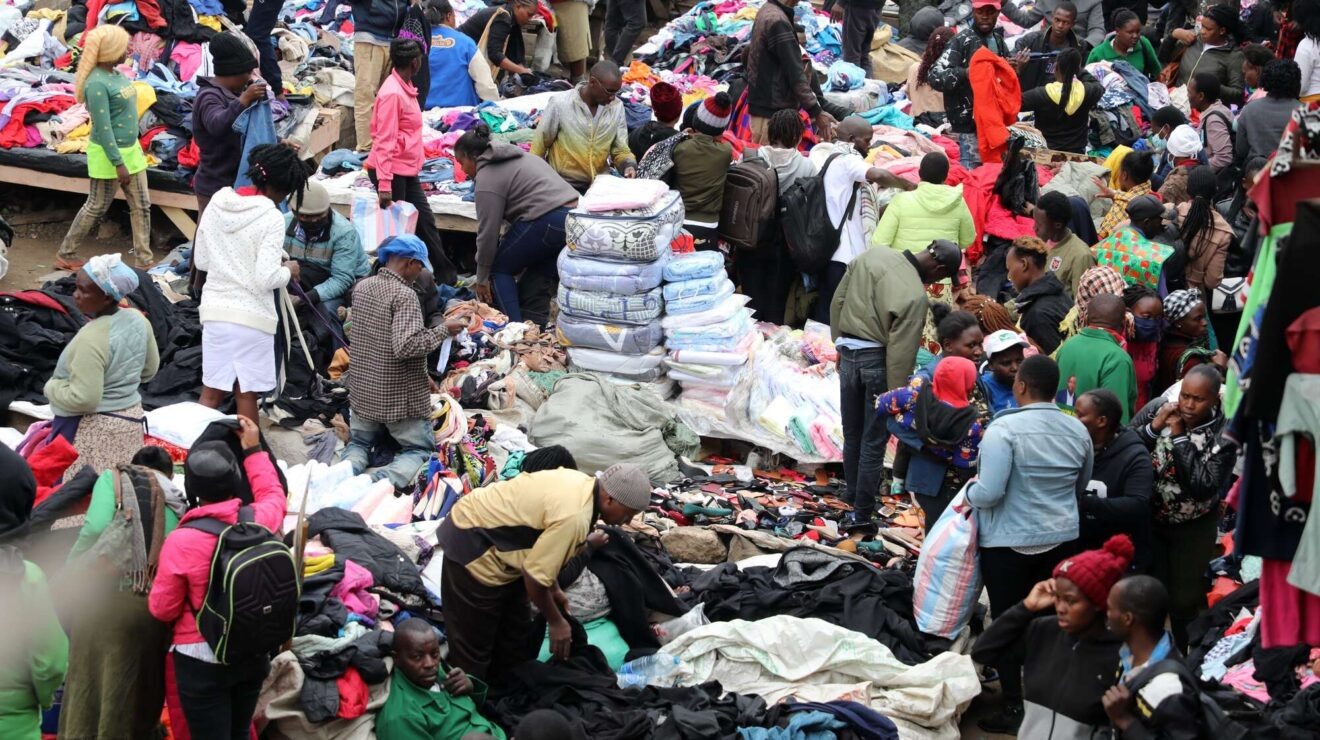
East African countries are once again debating how to reduce imports of secondhand clothes, commonly known as mitumba, as governments seek to grow local textile industries and create more manufacturing jobs.
The debate has resurfaced across the region, with countries such as Uganda introducing new taxes on used clothes while Kenya recently faced public backlash over proposed changes to taxation on mitumba imports.
In Kenya, mitumba remains a major part of daily life, especially in busy markets such as Gikomba Market, where thousands of traders and shoppers rely on the second-hand clothing business for income and affordable fashion.
Despite heavy rains and flooded pathways, traders at Gikomba continue to attract large crowds searching for cheaper clothes imported mainly from the United States, Europe and China.
Fashion designers and manufacturers across East Africa argue that the growing influx of used clothes is hurting local industries by making it difficult for locally made garments to compete on price.
Kenyan fashion designer Zia Bett said local brands are struggling to compete with low-cost second-hand clothing.
“We’re competing with second-hand clothing, but we can’t compete on price,” she said in an interview.
In Tanzania, Dar es Salaam-based designer Elizabeth Paul said many customers choose second-hand clothes because they are cheaper and easier to afford.
The East African Community (EAC) had earlier attempted to phase out mitumba imports in 2015 by proposing higher tariffs and an eventual ban. However, the plan collapsed after pressure from the United States, which warned that such restrictions could affect trade relations under the African Growth and Opportunity Act (AGOA).
Only Rwanda maintained its tough stance on second-hand clothes, increasing taxes on imported used garments from $0.20 to $2.50 per kilogram in 2016.
According to Rwanda’s trade ministry, the move reduced the share of second-hand clothing imports significantly while supporting the growth of the country’s local garment sector. However, reports indicate that smuggling of mitumba from neighbouring countries still continues.
Uganda levies an additional tax of 30 percent on used clothing imports in addition to the 35 percent import duties and 18 percent VAT already imposed.
According to Ugandan government officials, the tax is intended to protect the environment as well as promote local manufacturing.
Nevertheless, mitumba dealers in the region maintain that the trade employs thousands of people and cannot just be curtailed suddenly.
The research commissioned by Mitumba Consortium Association of Kenya estimates that over 4.9 million individuals within East Africa make a living from mitumba business, which includes traders, carriers, tailors, and food sellers.
Yet again, it remains debatable whether there is sustainable economic benefit to the sector compared to manufacturing locally.
Dr Andrew Brooks, an academic at King’s College London, said countries that mainly rely on importing and reselling used clothes gain little in terms of industrial growth.
Environmental concerns have also intensified the debate. Activists argue that a large percentage of imported used clothing ends up as waste because some items are too damaged or poor in quality to be reused.
According to the Changing Markets Foundation, more than one in three second-hand clothing items shipped to Kenya in 2023 ended up as waste.
Environmental groups have warned that countries like Kenya lack proper systems to manage the growing textile waste.
At the same time, some experts believe East Africa is still not ready to fully ban mitumba due to weak manufacturing capacity and the continued demand for affordable clothing.
Ugandan designer Joel Okalany said the region’s textile sector still faces major production challenges that make it difficult to replace imported clothes entirely.
Others argue that cheap new clothes imported from countries such as China and Turkey are posing an even bigger threat to both local manufacturers and mitumba traders.
Even with the ongoing debate, many consumers across Kenya, Tanzania and Uganda continue to prefer second-hand clothes because they are affordable, durable and unique.
Mitumba traders are now calling for governments to allow both local manufacturing and second-hand clothing businesses to coexist rather than eliminating one completely.
READ ALSO: Oil Prices Ease as US-Iran Talks Raise Hopes of Ceasefire Deal