
KCB Foundation has partnered with several organisations to launch Green Economy Programme aimed at helping small businesses in Kenya adopt environmentally sustainable business practices and grow within the green economy.
The initiative, dubbed Tujenge Pamoja, is being implemented with support from Hivos, Kenya Private Sector Alliance (KEPSA), Somo, and United States International University-Africa under the European Union-funded SWITCH Africa Green Programme.
The programme seeks to support Kenya’s shift from the traditional “take, make and dispose” economic model to a circular economy that focuses on recycling, reuse, repair, and reducing waste.
Under the initiative, about 3,200 Micro, Small and Medium Enterprises (MSMEs) will receive support to adopt sustainable business models that are both environmentally friendly and commercially viable.
The programme will also strengthen 40 Business Support Organisations and Technical and Vocational Education and Training institutions to help them serve as innovation and enterprise development hubs.
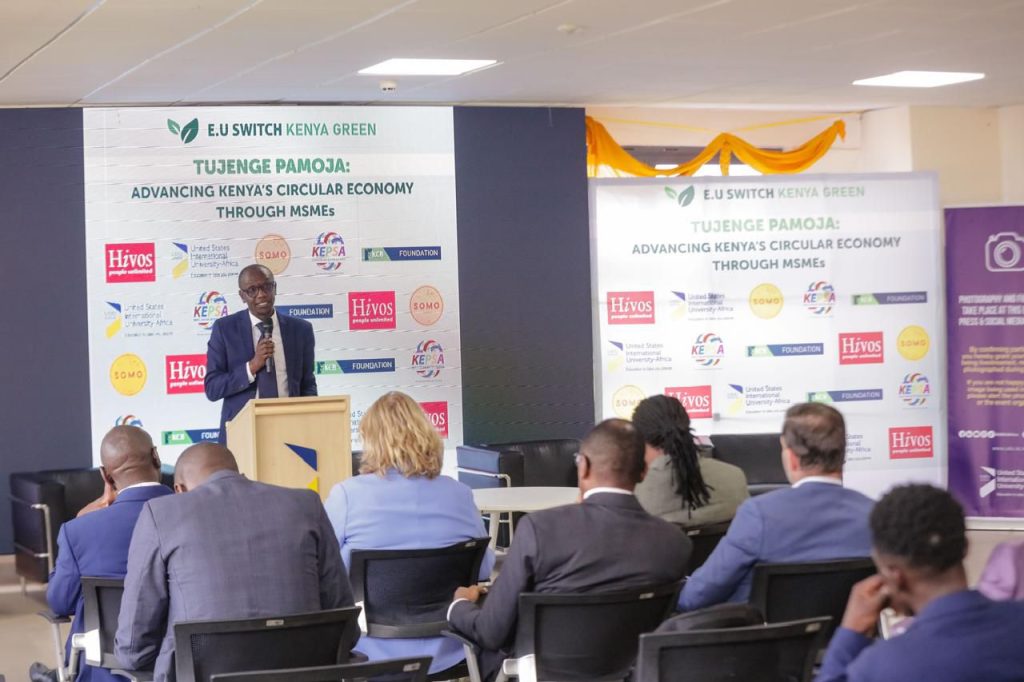
Speaking during the launch in Nairobi, Mendi Njonjo, Director of KCB Foundation, said the initiative is expected to help small businesses become more resilient while creating employment opportunities.
“This programme is about creating opportunities for small businesses and helping them grow through green financing, innovation, and skills development,” Njonjo said.
This project would also contribute to the development of green employment opportunities, especially for women and young adults, while contributing to businesses that seek to lower their carbon footprint and waste.
As per the partners of this programme, it will target different industrial sectors including plastics and packaging, sustainable textiles, composting and biogas solutions among others.
EU ambassador to Kenya, Henriette Geiger, has stated that the transition into a circular economy brings environmental as well as economic benefits to Kenya.
“The move towards sustainable business models can also encourage innovation, generate jobs and promote economic growth,” Geiger has stated.
Moreover, this programme also has a particular focus on women-owned, youth-owned and marginalised businesses in order to facilitate the inclusion of these groups in the green economy.
It has been further explained by the officials that this programme falls in line with Kenya Vision 2030, climate commitments made by Kenya under the Paris Agreement and promotion of sustainable economic development.
The increasing emphasis on sustainable development by private and public institutions around the world would make programmes like Tujenge Pamoja more relevant for Kenyan businesses in future.