
YouTube is raising the threshold new creators must meet to access advertising and Premium revenue sharing, a move that could make it harder for smaller channels to turn growing audiences into platform income.
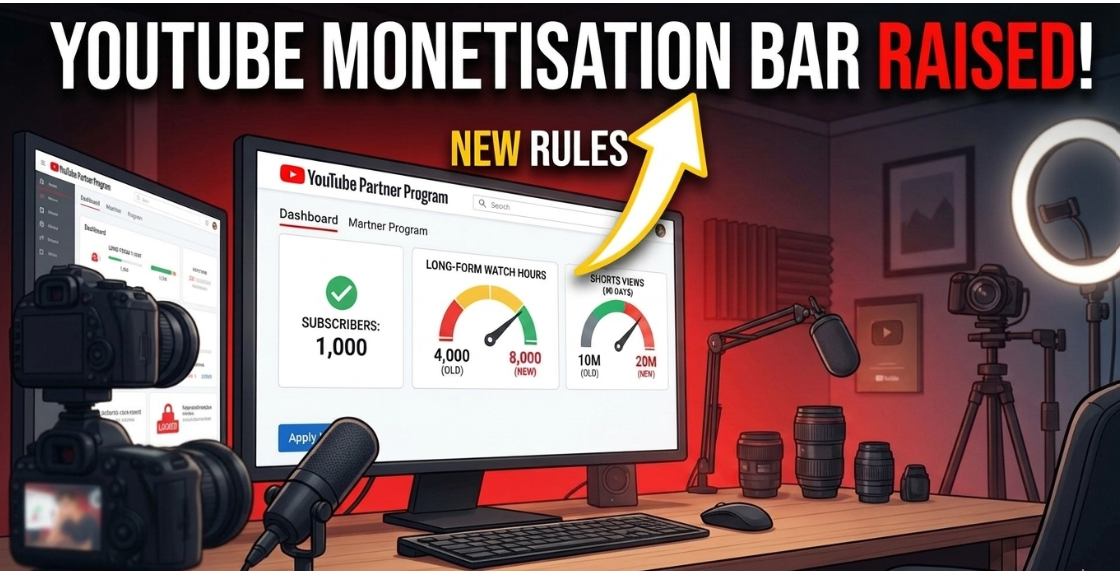
The new rules will take effect on February 1, 2027. New creators seeking access to advertising and Premium revenue sharing will need at least 1,000 subscribers and either 8,000 qualified public watch hours in the previous 365 days or 20 million qualified Shorts views in the previous 90 days.
The current thresholds are 4,000 watch hours or 10 million qualified Shorts views, meaning the two main audience requirements for new applicants will double.
YouTube says the changes are the first major update to the YouTube Partner Program (YPP) since 2018. The company says the programme now has more than three million creators and that it expects to pay creators more in 2027 than it did in 2026.
The change does not mean that every YouTube monetisation option is becoming harder to access.
YouTube will keep the existing eligibility requirements for Fan Funding and shopping products. Creators can therefore still use some direct-to-fan and commerce tools without first reaching the new 8,000-hour or 20 million-Shorts-view thresholds.
Shorts creators face a higher entry target
For creators using Shorts to qualify for advertising and Premium revenue sharing, the new entry requirement will be 20 million qualified Shorts views over 90 days.
There is, however, a separate requirement for creators who are already in the Partner Program and want to continue receiving revenue sharing from Shorts.
From February 1, 2027, those creators will need at least 10 million qualified Shorts views over a 90-day period to receive advertising and subscription revenue sharing on Shorts.
A creator who falls below that figure will not automatically be removed from YPP. Instead, the Shorts revenue-sharing benefit can stop until the channel again meets the required view threshold.
The distinction is important because the 20 million and 10 million figures serve different purposes.
Twenty million views is the new entry benchmark for a creator trying to qualify for the advertising and Premium revenue-sharing tier through Shorts. Ten million views is the ongoing requirement for Shorts revenue sharing for creators already in the programme.
YouTube says the move is partly aimed at making Shorts advertising a more meaningful source of income for creators. The platform records more than 200 billion Shorts views each day, highlighting the enormous scale of short-form video on the service.
Smaller creators may need other income streams
For creators starting out, the higher thresholds mean that building an audience alone may not be enough to quickly qualify for YouTube’s largest advertising revenue-sharing tier.
This could be particularly important for creators in African markets, where platform advertising is often only one part of a wider digital business.
A Kenyan creator, for example, may build an audience on YouTube while relying on sponsorships, brand partnerships, direct sales, memberships, events or other work to supplement platform income.
The new YouTube rules do not remove those options. In fact, the company is also expanding other ways for creators to earn.
YouTube says it will introduce new incentive opportunities around YouTube Shopping, brand deals and trends. Fan Funding will also remain available under its existing eligibility requirements.
Under the current lower YPP tier, creators can access Fan Funding with 500 subscribers, three public uploads in the previous 90 days and either 3,000 public watch hours in the previous year or three million qualified Shorts views over 90 days.
That means smaller creators are not being shut out of YouTube’s wider monetisation system, even as the requirements for advertising and Premium revenue sharing become tougher.
YouTube is also expanding Premium Lite
The changes to advertising thresholds are coming alongside an expansion of YouTube Premium Lite.
YouTube says Premium Lite will be expanded to every country where YouTube Premium is available. The lower-cost subscription is designed to provide uninterrupted viewing for most content, alongside features such as offline downloads and background playback.
The company says 60% of net Premium Lite subscription revenue will be allocated to a creator pool. For full Premium, YouTube says creators receive a share based on members’ viewing activity.
YouTube also says creators, on average, earn more from a Premium subscriber than from that user’s advertising-supported viewing, based on its 2026 performance data.
The expansion gives YouTube another way to generate revenue from viewers while giving creators an additional income channel beyond traditional advertising.
X takes a different approach
The changes at YouTube come as X is also changing how it rewards creators.
On August 7, 2026, X stopped accepting new enrolments into its existing Revenue Sharing programme. Creators already enrolled can continue earning through September 7, after which the programme will be replaced by the Original Content Rewards Programme.
The new system places more emphasis on original work.
According to X, qualifying content can include original writing, reporting, analysis, photography, video, memes and commentary. The platform says simply reposting someone else’s material, adding a small caption or making minor changes will not meet its originality requirements.
To qualify, creators will need at least 500 verified followers and 500,000 Home Timeline impressions from verified users during the previous 90 days, among other requirements.
X’s approach is different from YouTube’s.
While YouTube is raising the amount of audience consumption required for new creators to access advertising and Premium revenue sharing, X is putting greater emphasis on the originality of the work generating audience attention.
For journalists, analysts and specialist creators, that distinction could be important.
A creator who adds original reporting, context or analysis to information already circulating online has a clearer way of showing what they bring to the platform. Simply republishing material from another account is less likely to qualify under X’s new system.
What the changes mean for African creators
For African creators, the latest changes point to a wider issue in the digital economy: building an audience and making money from that audience are not always the same thing.
Creators may increasingly need to combine platform payments with sponsorships, brand partnerships, commerce, fan support and their own digital products or services.
This is especially relevant for creators whose audiences are spread across different countries and platforms. A creator may have a strong following but still face different advertising economics depending on where those viewers are located.
YouTube’s decision to retain lower thresholds for Fan Funding and shopping gives smaller creators some room to build income before reaching the new advertising requirements.
At the same time, X’s focus on original reporting, analysis and other original work shows another direction platforms are taking as they try to decide which creator activity should receive direct payments.
For professional creators, including journalists, commentators and technology specialists, producing original material could therefore become increasingly important alongside audience growth.
The creator business is changing
YouTube and X are taking different approaches, but the changes on both platforms point to a similar shift.
Platforms are becoming more selective about the activity they directly reward.
YouTube is raising the audience threshold for new creators seeking advertising and Premium revenue sharing while expanding other income opportunities around subscriptions, shopping and brand deals.
X, meanwhile, is moving away from its previous Revenue Sharing model and introducing a programme that places more weight on original content and qualified audience attention.
For creators, the message is fairly simple: having followers still matters, but it may no longer be enough to depend on one platform or one source of income.
The creators who can build an audience while also developing other ways to earn may be better placed to deal with changes in platform policies.
For new YouTubers, however, the immediate reality is clear. From February 2027, reaching 1,000 subscribers will still be necessary for the main advertising and Premium revenue-sharing tier, but creators will need twice as much qualifying watch time or Shorts views to get there.
ALSO READ: Top 10 highest paying YouTube niches