
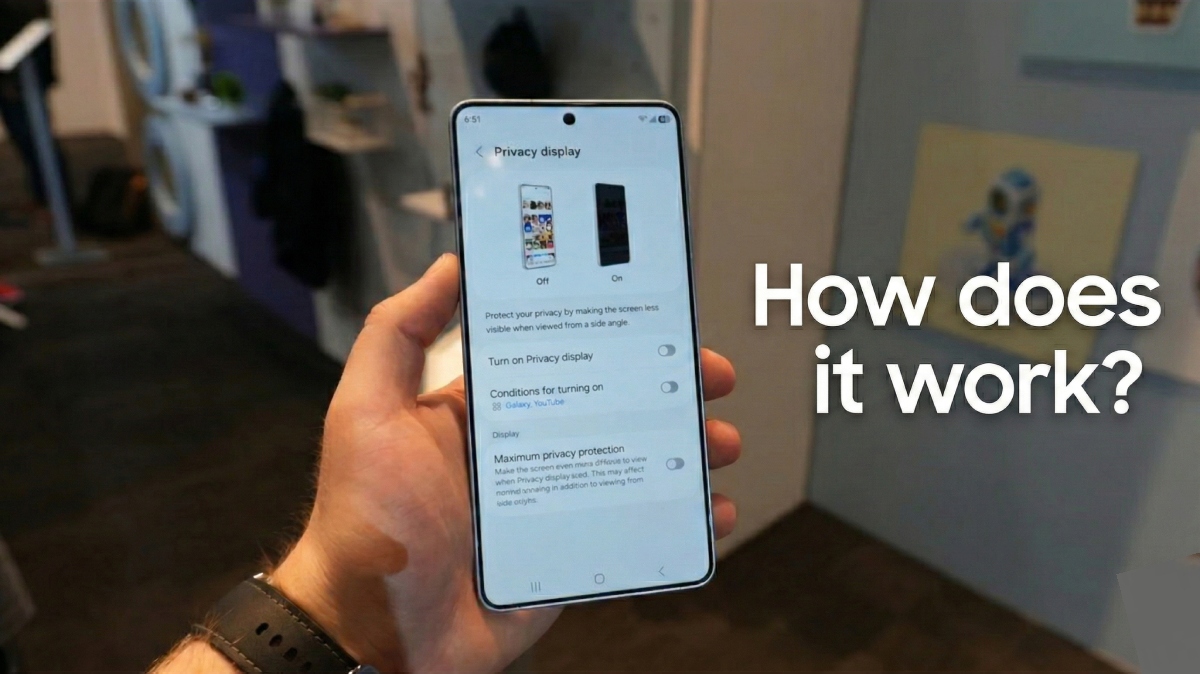
Samsung has once again raised the bar for mobile displays with the Galaxy S26 Ultra, effectively killing off the market for plastic protectors by introducing a revolutionary Inbuilt Privacy Screen.
This new Inbuilt Privacy Screen (leveraging Flex Magic Pixel tech) is a hardware-level masterpiece that allows you to secure your data with a single tap in One UI 8.5.
It is a sophisticated application of advanced optical physics and material science that changes how photons exit the display stack.
To understand how this “invisible” security layer functions, we must analyze the five core engineering pillars that transition the display from a wide-angle transmitter to a directed photon beam.
1. The Active Liquid Glass Switch Engine
Unlike static films, Samsung has integrated a three-layer optical sandwich directly into the Dynamic AMOLED 2X panel architecture.
This isn’t just a simple filter; it is an active optical switch capable of changing states in milliseconds.
The “engine” consists of a Variable Refractive Layer (VRL) made of specialized liquid crystal glass that reacts to precise electrical currents.
When you need privacy, the system shifts these liquid crystals to act as a software-defined lens, a concept explored in modern photonics research.
2. Stealth Mode via Total Internal Reflection
The real “magic” happens through the physics of Total Internal Reflection (TIR), a principle commonly used in fiber optic communication.
In Standard Mode, the refractive index of the display layers matches perfectly, providing the 178-degree viewing angles we expect from a flagship.
Once you toggle Privacy Mode on, the S26 Ultra applies a voltage that creates a “refractive mismatch” within the glass stack.
This mismatch effectively “traps” wide-angle light rays, bouncing them back into the display chassis so they never reach a “shoulder surfer.”
3. Light Steering with Narrow Pixel Architecture
The S26 Ultra uses a hybrid layout featuring a microscopic Black Matrix architecture, as discussed in DisplayMate’s technical deep dives.
- Narrow-Emission Pixels are physically “ringed” to funnel light strictly forward on the z-axis.
- Wide-Emission Pixels provide the broad light dispersion required for high-brightness HDR content.
In Maximum Privacy Mode, the display driver (DDI) dims the wide pixels and forces the narrow pixels to handle 100% of the luminance load.
4. Selective Obscurity and GPU Masking
Because this is a hardware feature baked into the silicon, it is incredibly intelligent and context-aware.
Powered by the Snapdragon 8 Elite’s Adreno GPU, the phone can perform Coordinate-Based Privacy.
This allows the OS to apply the privacy “voltage” only to specific X/Y coordinates on the screen, such as a banking login field.
It even integrates with Samsung Knox to auto-trigger when you enter a “Secure Folder” or open a confidential work email.
5. Performance Benchmarks Against Traditional Overlays
For the spec-obsessed Samsung fans, the performance gap between this inbuilt tech and a $20 film is massive.
Traditional films typically degrade the screen quality, but the Inbuilt Privacy Screen maintains a native flagship experience:
| Specification | S26 Inbuilt Privacy Screen | Traditional Privacy Film |
|---|---|---|
| Optical Mechanism | Active LC Refraction / TIR | Passive Micro-Louver Blocking |
| On-Axis Brightness | ~2,500+ nits | ~30% – 40% permanent light loss |
| Resolution | Full QHD+ Clarity | Often “grainy” or “pixelated” |
| Biometrics | 100% Ultrasonic Efficiency | Frequent fingerprint scan failures |
6. Enterprise-Grade “Visual Hacking” Defense
Samsung is clearly positioning the S26 Ultra as the ultimate tool for secure mobile productivity.
With the NPU inside the S26, the phone can use the front camera to detect if an unauthorized person is peeking over your shoulder.
The system then automatically tightens the viewing cone in real-time, providing a defense against “visual hacking” as defined by NIST security standards.
This Inbuilt Privacy Screen is a game-changer for anyone concerned with safeguarding confidential data while traveling or working in public.
Technical Resources: