Okoa Uchumi, a civil society group, demanded that the government introduces urgent fiscal reforms aimed at restoring transparency, accountability, and public confidence in Kenya’s financial management system.
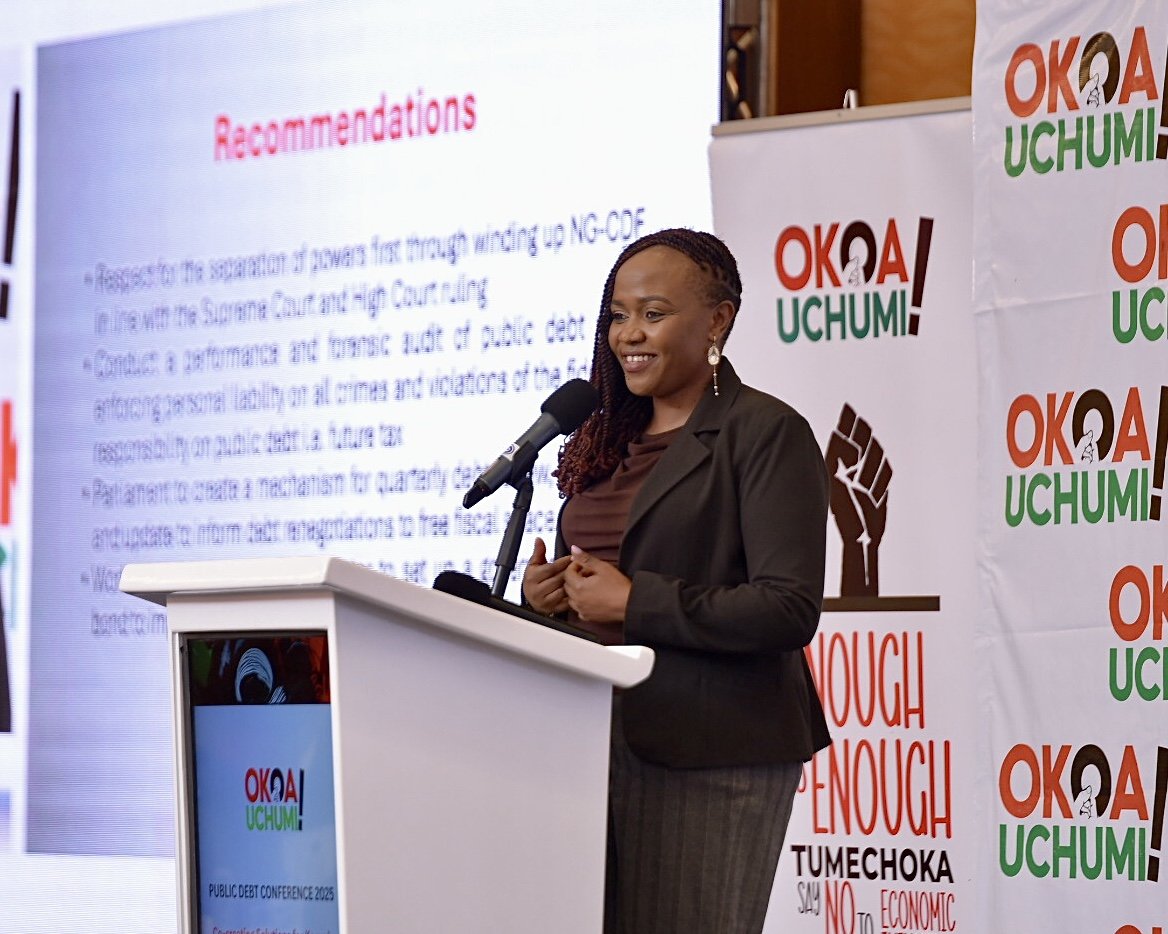
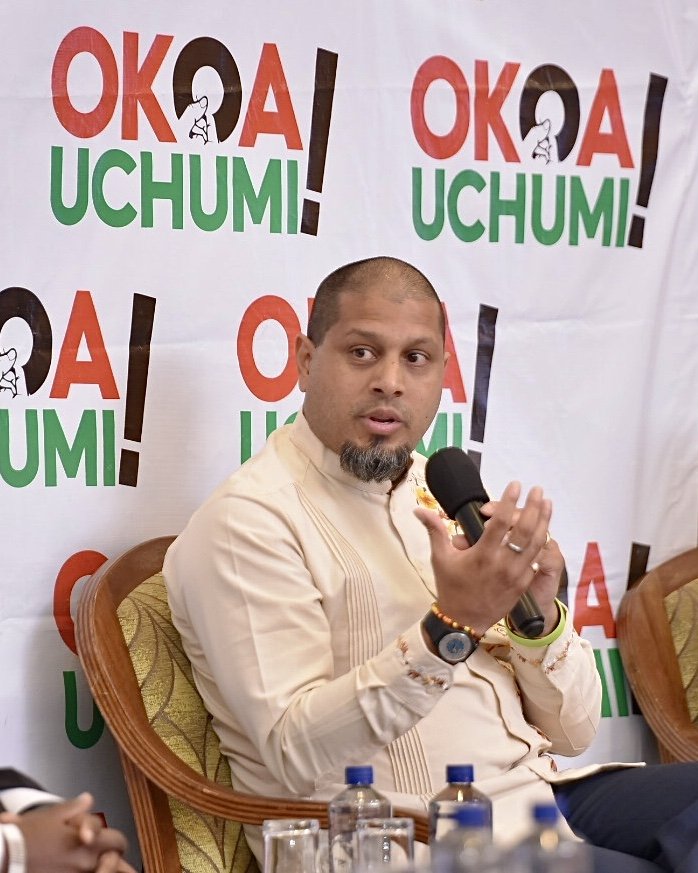
Addressing a launch of a national fiscal accountability report, The Institute for Social Accountability (TISA) Executive Director Diana Gichengo said that Kenya’s deepening economic crisis is the culmination of poor expenditure management, political capture of public funds, and institutional weakness.
She positioned the new report as a “patriotic resistance” a citizen action to protect the Constitution and demand prudent use of taxpayers’ money.
“Public funds are not lost because we lack money, but as a result of poor management of public money. We need to demand receipts for each borrowed and spent shilling in our names,” Gichengo said.
Piling up Debt and Narrowing Civic Space
Kenya’s public debt continues to rise geometrically, rising to Ksh11.81 trillion on June 30, 2025. Of this figure, Ksh6.33 trillion (53.5%) is domestic debt, and Ksh5.49 trillion (46.5%) is foreign.
According to the report, the growing deployment of short-term borrowing through the use of Treasury bills and bonds has expanded fiscal stress, with hardly anything left over to fund such services as health, education, and social protection.
Gichengo also sounded alarm at the shrinking civic space with instances of abductions and police brutality that have frustrated citizens and activists from holding the government accountable.
She called for greater coordination among citizens, civil society, and institutions of oversight like the Auditor-General and Controller of Budget to prevent unwise use of public funds.
Key Observations from the Report
Economic Mismanagement: Kenya’s problem is not limited revenue but unrestricted spending.
Ongoing supplementary budgets and unmonitored expenditure have opened windows of corruption.
Weak Oversight: Parliament and other oversight bodies have failed to exercise accountability, often succumbing to political needs at the cost of fiscal responsibility.
High Cost of Borrowing: The country still borrows locally at 16–18% interest rates, far higher than the global average of below 4%.
Opaque Privatization Deals: The fresh round of privatization and Public-Private Partnership (PPP) schemes lacks transparency and proper parliamentary scrutiny.
Money Laundering and Waste: Supplementary budgets and the misuse of development funds have become avenues for money laundering and economic wastage.
Okoa Uchumi’s Main Recommendations
Abolish Supplementary Budgets: End the frequent use of mini-budgets that inflate deficits and enable fund misuse.
Respect Separation of Powers: Parliament should stop managing development funds like CDF, which compromise accountability.
Ensure Debt Transparency: The Treasury needs to provide detailed loan data showing how loans are accessed, spent, and serviced. All untold and parliament-authority-not-approved debt cannot be serviced.
Renegotiate Costly Loans: Review and re-finance expensive foreign debts in an effort to ease the economy.
Implement Zero-Based Budgeting: Build each year’s budget from the ground up such that each expense must be justified and spending relates to national priorities.
Empower Oversight Institutions: Fully fund and boost the Auditor-General and Controller of Budget to enable live audits and checks for compliance.
Reform the PPP Act: Re-establish parliamentary oversight of PPP projects to promote transparency and protect public assets.
Tighten Anti-Corruption Laws: Introduce stiffer penalties for corruption and procurement fraud under existing anti-corruption legislation.
Regulate Privatization: Privatize state corporations like Kenya Pipeline and Kenya Airways in open, public-interest-driven processes.
Conduct Forensic Audits: Conduct deep investigations into ministries and agencies suspected of wastage or corruption, while enhancing anti–money laundering efforts.
Promote Citizen Participation: Involve citizens in engagement in national and county budgets to demand accountability and better delivery of services.
Gichengo pointed out that if Parliament and the Executive fail to act on the draft reforms, Kenyans enjoy a constitutional right under Article 3 of the Constitution to safeguard the financial integrity of the nation.
“When the people’s confidence is betrayed by public institutions, the people have to reclaim their power and seek accountability,” she said.
Debt as an Instrument of Oppression
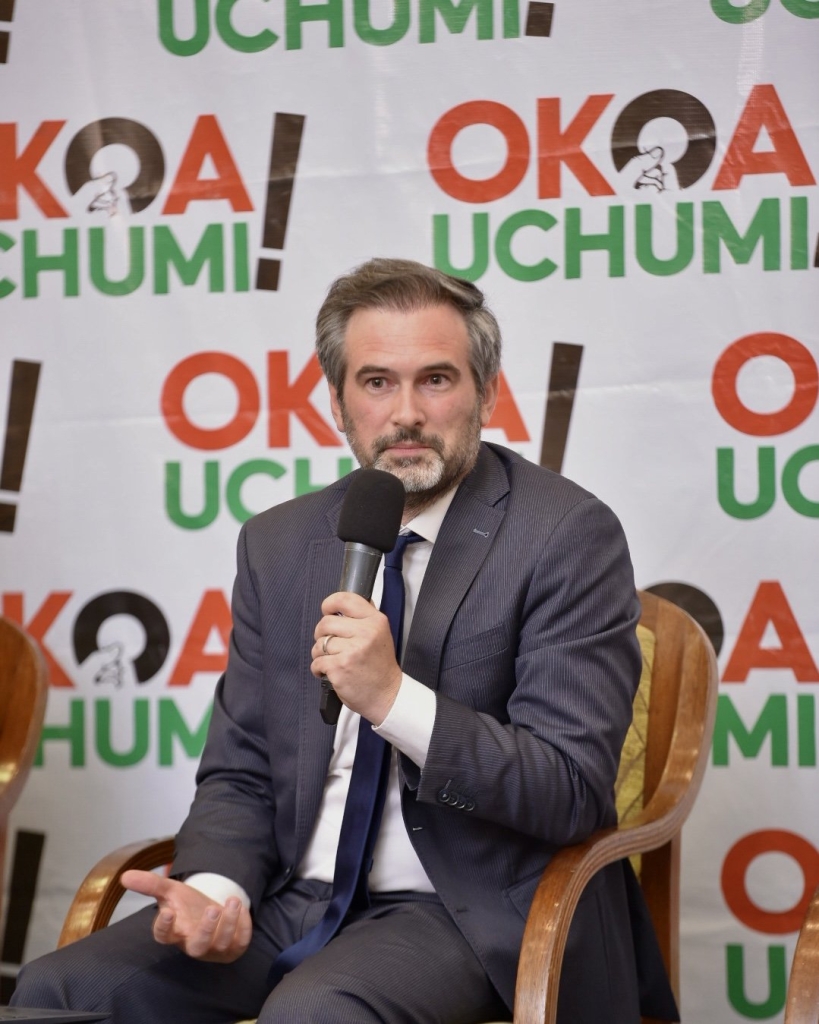
AFRODAD Executive Director Jason Braganza further noted that Kenya must start treating debt as more than a merely financial issue.
“Debt is typically addressed as just a financial instrument, but for Kenya and indeed most nations, it can also be an instrument of oppression. It has impacts beyond figures it has governance, social justice, and accountability implications,” he stated.
National Democratic Institute (NDI) Country Director Dennis Omondi also noted that mismanagement of public finances in Kenya has turned into a governance and democracy matter, despite having strong laws and frameworks.
“Time and time again, the powers that be have ignored these frameworks. All that is left now is for citizens to demand loudly accountability,” he stated.
Read Also: Kenya Budget 2025/26 Criticized as Regressive and Anti-Poor by Okoa Uchumi