

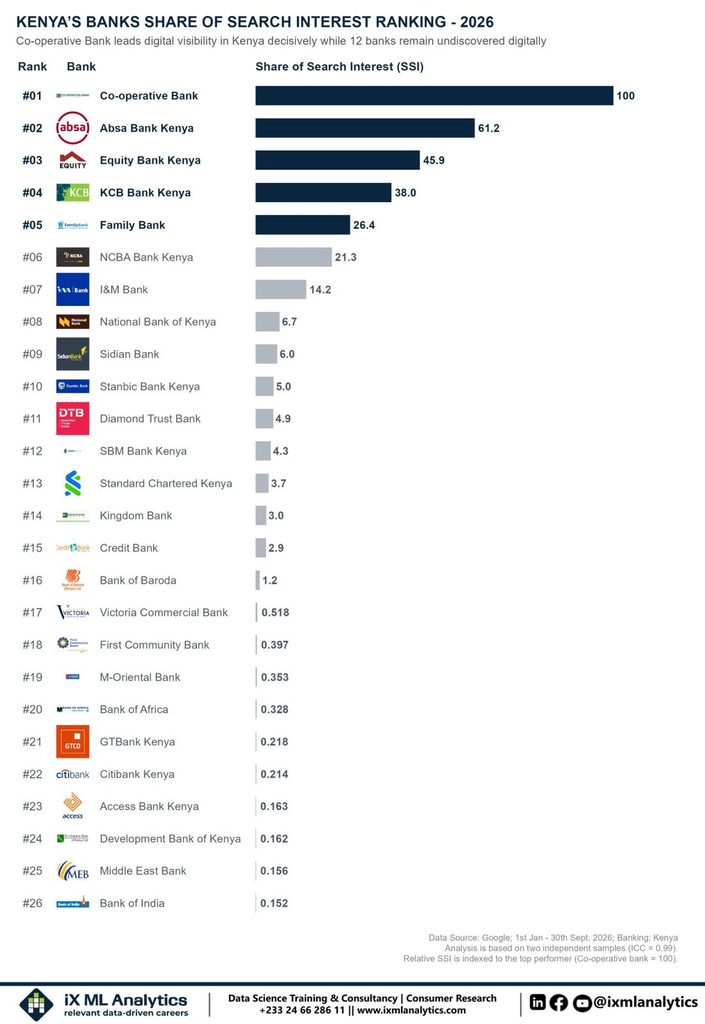
Co-operative Bank of Kenya has emerged as the most searched commercial bank in a study covering January to September 2026, placing it ahead of Absa, Equity and KCB as lenders compete for online visibility.
The analysis by iX ML Analytics, a data science and business analytics firm, examined search trends across 38 commercial banks in 41 urban centres over 40 weeks, according to a report published by Citizen Digital on October 28, 2026.
Co-op Bank recorded a Share of Search Interest (SSI) score of 100, followed by Absa Bank at 61.24, Equity Bank at 45.90, KCB Bank at 37.96 and Family Bank at 26.42.
The results put Co-op Bank at the top of the study’s national comparison. However, the SSI score is a measure of relative search interest, not the number of customers a bank has or the volume of business it handles.
The findings come as banks increasingly compete for customers through mobile banking, digital payments and online channels, alongside their traditional branch networks.
Search interest varies across towns
The study found that online interest in banks differed from one urban centre to another, suggesting that a lender’s visibility nationally does not necessarily translate into the same position in every market.
Co-op Bank recorded search-interest shares of 82% in Siaya, 81% in Mariakani and 80% in Maua. It also led in Migori, with 47%, and Eldoret, with 42%.
Other banks performed strongly in selected locations. Absa recorded 100% in Masimba and 65% in Garissa, while KCB led in Webuye with 55% and Voi with 42%. Equity also recorded strong results in several towns, including Karuri and Tatu City.
The analysis reported an increase in search activity across several lenders during the week of July 26, 2026. Equity’s SSI score rose to 79 from 33.4, while KCB’s increased to 70.5 from 27.5. Credit Bank also recorded a sharp increase, rising to 48 from a baseline of about 2.1.
The report did not establish what caused the increase, meaning it would be premature to attribute the changes to particular marketing campaigns or product launches.
The figures nevertheless show why banks need to look beyond national rankings when assessing their online presence. Local search patterns can help identify where consumers are showing interest, although further research is needed to establish whether that interest leads to account openings or use of banking services.
Co-op Bank’s social media following
Co-op Bank also has a substantial social media audience at the time, the lender had 2.2 million Facebook followers, 744,900 on X, 468,000 on TikTok and 88,000 YouTube subscribers.
KCB had 1.5 million Facebook followers, 633,100 on X, 82,800 on TikTok and 49,600 YouTube subscribers. Equity Bank recorded 1.3 million Facebook followers, 494,500 on X, 35,700 on TikTok and 19,600 YouTube subscribers.
Instagram presented a different picture. Equity led with 94,400 followers, compared with 87,000 for Co-op Bank.
The June figures indicate that Co-op Bank had built a larger audience than KCB and Equity on four of the five platforms compared in those figures. They do not, however, establish its current October ranking because social media audiences can change over time.
The figures also measure followers rather than the number of people who regularly interact with the bank’s content or become customers through its digital channels.
What the figures mean for the Ignite youth proposition
Co-op Bank’s search visibility and social media following could give it an advantage in reaching younger consumers through its Ignite youth proposition.
The bank’s stated strategy is to use its digital presence to reach young people and build a community around entrepreneurship, careers, innovation and financial literacy.
Platforms such as TikTok offer a way to explain banking products in short videos and reach users who may not actively seek information through traditional advertising. Content on saving, budgeting, digital payments and fraud prevention could also help young consumers make informed financial decisions.
For students, young professionals and entrepreneurs, accessible information can be an important starting point when comparing banking services. However, the usefulness of such content will depend on whether it answers real customer questions and clearly explains the costs, terms and requirements of the products being promoted.
A large online following may help a bank distribute that information, but it does not automatically translate into more customers or lower marketing costs. Those outcomes would need to be measured using campaign results, account openings and customer activity.
Digital visibility is only part of the picture
The latest search analysis gives Co-op Bank a strong position in online brand visibility among the 38 lenders studied. Its June social media figures also show a substantial audience on several major platforms.
These, however, are different measures of the banks’ digital presence. Search interest measures how often the brands are searched for online compared to other competitors, whereas followers measure the extent of the banks’ audiences on social media.
On their own, these measures do not demonstrate which banks have the best digital banking services, the most active customers or customer satisfaction.
For Co-op Bank, the challenge is to translate that visibility to deeper customer relationships, especially with the younger generation that is just venturing into banking and seeking financial products that suit them.
Whether or not the bank is able to translate this online visibility to product usage will be determined by factors like convenience, affordability, security and customer service.
The results prove that indeed Co-op Bank is the leader in digital banking visibility. The future success of the bank lies with what it does with this visibility.