
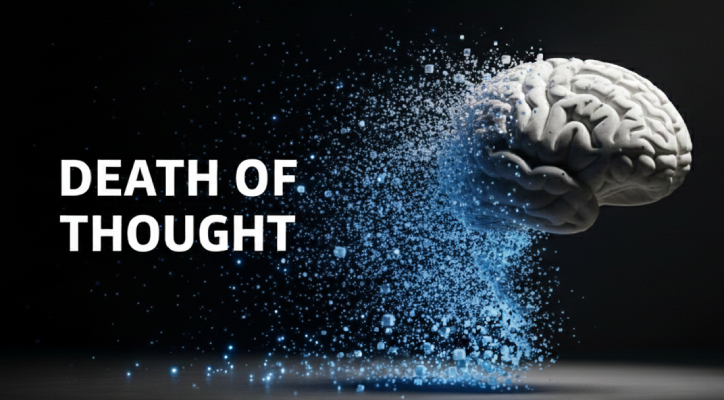
Social Media has fundamentally altered the landscape of the human mind by a massive degree. Take a moment to look around at the world today and notice how every single person is staring into a glowing rectangle while life passes them by.
In 2008, the average human attention span was 12 seconds, but by 2026, research indicates it has plummeted to just 8 seconds—shorter than that of a goldfish.
Humans were once defined by their unique capacity for deep contemplation. We could sit in a room alone and follow a complex thought to its end.
That version of humanity is being systematically phased out, as digital platforms now cause teen users to toggle between apps every 44 seconds on average (Nature Communications, 2024).
How Social Media Dismantles Cognitive Autonomy
We are living through the largest psychological experiment in history. The goal of Social Media is not to connect you but to dismantle your cognitive autonomy.
A 2025 study from the University of California found that heavy users (5+ hours daily) are 33% more likely to experience “attention fragmentation,” effectively losing the ability to sustain a single train of thought.
Silicon Valley engineers discovered a dark truth about the human brain. Deep thinking is a direct threat to corporate profit.
If you are contemplating life then you are not scrolling, and every 45 minutes of active scrolling leads to a measurable peak in “cognitive fatigue” as reported by the Center for Humane Technology.
To keep the machinery running they had to break your mind. They replaced the act of thinking with the dopamine hit of the scroll.
Research from Stanford Medicine likens the smartphone to a “modern-day hypodermic needle,” delivering digital dopamine directly to the reward pathways of a wired generation.
It is the same mechanism used in Vegas slot machines. You pull the lever of the infinite scroll on Social Media without knowing what comes next.
READ ALSO; Samsung Galaxy S26 Ultra Release Date and Price in Kenya
This “intermittent reinforcement” is so effective that 63% of people now admit to checking notifications within 60 seconds of receiving them (Asurion Tech Report, 2025).
Your brain is a plastic organ that adapts to its environment. Spending hours in fifteen-second increments causes your neural pathways to wither.
Social Media is training you to be incapable of focus; studies show that prolonged exposure to rapid content streams decreases working memory efficiency by 11% (NeuroImage Study, 2025).
When was the last time you experienced true boredom. Boredom used to be the primary gateway to human creativity. It was the moment your brain started the work of internal reflection.
Today that silence has been completely eradicated by content. Every gap in your day is filled with digital noise. We have successfully outsourced our inner dialogue to a cold algorithm, with 45% of teens now admitting they spend “too much time” online, a sharp increase from previous years (Pew Research Center, 2025).
You do not have original opinions anymore. Social Media provides prepackaged takes designed by a machine to maximize your outrage.
You wait for the feed to tell you how to feel, while the “echo chamber” effect ensures you never encounter a thought that hasn’t been algorithmically approved for you.
The Self is being replaced by a digital mirror. It only reflects what the algorithm thinks will keep you engaged.
You are losing the ability to see your own reality clearly, as 63% of social media users now report chronic feelings of loneliness despite being “connected” (World Health Organization / WHO, 2025).
We think we are getting smarter because we consume more information. But information is not knowledge and knowledge is not wisdom.
We are actually experiencing total cognitive fragmentation, a state where the brain becomes reliant on digital sources for memory, a phenomenon known as “digital amnesia.”
Our attention is being shattered into a million tiny pieces. We can no longer synthesize complex ideas because we cannot hold focus.
On Social Media, we know everything about absolutely nothing at all; session durations have dropped from 2.7 minutes in 2013 to just 54 seconds today (Statista Digital Trends, 2025).
This is not an accident or a technical glitch. A shallow population is significantly easier for the system to manage.
A fragmented mind is easier for the state to manipulate through digital channels, as cognitive failure scores now show a direct positive correlation with daily media multitasking frequency (Journal of Experimental Psychology).
The end goal is to turn you into a predictable data point. A thinking human is unpredictable and dangerous to the status quo. They question the narrative and they eventually opt out.
A user reduced to Pavlovian responses is a literal goldmine. You are being farmed for your attention every single hour.
Your cognitive decline is the primary export of the Social Media era, where “brain rot” is becoming a clinical observation of emotional desensitization and cognitive overload (National Institutes of Health / NIH, 2025).
Disconnecting is no longer just a digital detox. It is an act of total revolution against the machine. It is a desperate attempt to reclaim your own mind from the grip of the platform.
The world is getting louder but we are understanding less. If you want to keep your intelligence you must be alone. Reclaim your silence from Social Media before it is gone forever.
References & Sources
Neurocognitive Impact: National Institutes of Health (NIH) (2025). “Modern Day High: The Neurocognitive Impact of Social Media Usage.
Attention Span Decay: American Psychological Association (2024). “Speaking of Psychology: Why our attention spans are shrinking, with Gloria Mark, PhD.”
Brain Structure Impact: Nature Communications (2024). “The Acceleration of Cultural Dynamics and the Fragmentation of Digital Attention.”
Teen Digital Habits: Pew Research Center (2025). “Teens, Social Media, and Technology Overview 2025.”







[…] READ ALSO; How Social Media Is Secretly Destroying Your Ability To Think […]