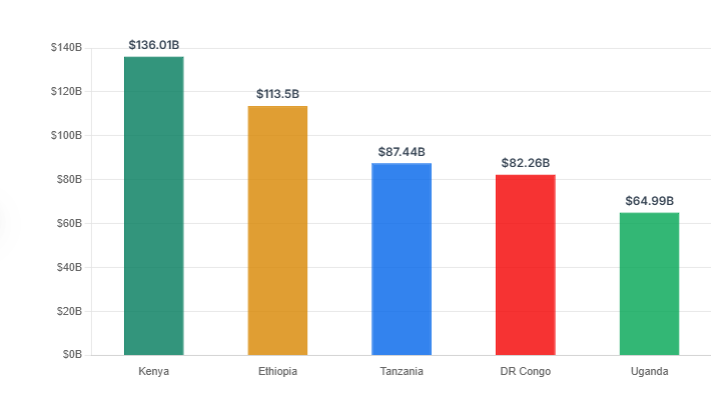
In a dramatic shift in the regional economic landscape, Kenya is set to reclaim its position as East Africa’s largest economy in 2025, surpassing Ethiopia’s GDP.
New projections from the International Monetary Fund (IMF) and regional economic analysts indicate a significant reshuffling of wealth in the bloc, driven largely by currency reforms, infrastructure investments, and resilient service sectors.
As the East African Community (EAC) continues to integrate the Democratic Republic of Congo (DRC) and Somalia, the region’s combined economic output is becoming a formidable force on the continent.
The 2025 outlook reveals a tight race at the top, with currency valuation playing a decisive role.
Projected Nominal GDP (2025)
Countries GDP
Kenya enters 2026 as the undisputed economic anchor. Its lead is powered by a diversified economy less reliant on raw commodities. The stability of the Shilling relative to neighbors has been the key factor in reclaiming the #1 spot.
2026 Value Play:Venture Capital Tech Hub (‘Silicon Savannah’).onomic drivers for each nation.
The Deciding Factor: Currency vs. Commodity
The 2025 rankings were largely defined by two opposing forces. Understanding this dynamic is crucial for interpreting why nominal rankings shifted even when real growth remained positive across the bloc.
Kenya’s return to the top spot is largely attributed to the stability of the Kenyan Shilling compared to its neighbors and a highly diversified economy.
Unlike many peers reliant on a single commodity, Kenya’s growth is fueled by a robust services sector, a thriving fintech ecosystem led by innovations like M-PESA, and a recovery in tourism.
In contrast, Ethiopia has faced a year of “painful medicine.” The government’s decision to float the Ethiopian Birr led to a sharp devaluation, which technically lowered its GDP value in US Dollar terms.
While the economy actually grew by 7% in local terms (see Deloitte’s analysis), the international “price tag” of the economy shrank to approximately $110 Billion.
The Resource Surge: Tanzania, DRC, and Uganda
While Kenya bets on services, its neighbors are doubling down on physical resources. Tanzania continues its steady, upward trajectory with massive infrastructure projects like the SGR (Standard Gauge Railway) positioning Dar es Salaam as a primary trade gateway.
Further inland, the Democratic Republic of Congo (DRC) is leveraging its position as the world’s leading producer of cobalt. With new export quotas capped at roughly 96,000 tonnes for 2026, the DRC aims to force global price increases.
Meanwhile, Uganda is on the cusp of an economic boom driven by the oil sector, with the EACOP pipeline triggering massive foreign direct investment.
Smart Money: Understanding the Numbers
To navigate these economic reports, it is essential to distinguish between Nominal and Real GDP.
Nominal GDP is calculated using current prices and exchange rates, making it good for comparing economic size on the global stage. However, it can be volatile during currency reforms.
Real GDP removes the effects of inflation to measure actual production growth.
By this metric, Ethiopia remains a manufacturing powerhouse with the region’s largest population, offering massive long-term potential despite its current nominal dip.
Outlook 2026: The Watchlist
As the region heads into 2026, three key trends will likely dictate the next shift in rankings. First is Regional Integration.
The EAC continues to push for a single currency roadmap, though a full union remains distant, tighter trade bonds are expected.
Second is Climate Resilience. After severe floods in recent years, 2026 national budgets are expected to prioritize “Green Growth” financing, essential for an agricultural sector that contributes nearly 30% of regional GDP.
Finally, Global Shocks remain a risk. As noted in recent investment outlooks, global interest rates will dictate how expensive it is for these nations to borrow money for development, potentially squeezing budgets in debt-heavy nations like Kenya and Ethiopia.