
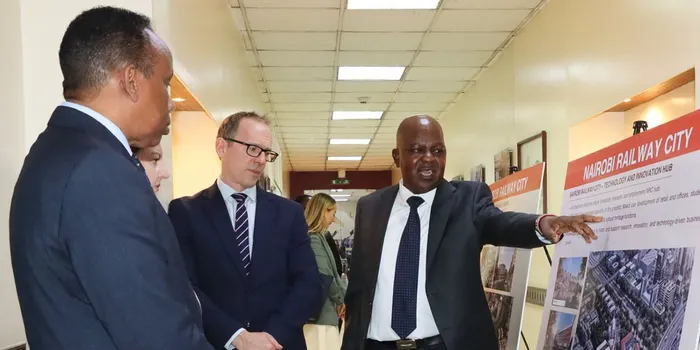
Kenya Railways is targeting early 2027 to complete funding arrangements and begin construction of the Ksh30 billion Nairobi Railway City project.
Managing Director Philip Mainga said the corporation was working with the National Treasury and other government agencies to secure the required financing before construction begins.
Mainga spoke on Thursday, November 19, following a meeting with United Kingdom officials to discuss funding and the implementation of the project.
He revealed that Kenya Railways had already completed the procurement process for the contractor and supervising engineer who will oversee the construction.
“Our immediate priority is to conclude the financing arrangements for Nairobi Central Station and move into construction,” Mainga said.
The corporation also announced plans to begin construction of the Meetings, Incentives, Conferences and Exhibitions (MICE) zone in the coming weeks.
The section will feature a modern multipurpose arena and commercial facilities intended to accommodate conferences, exhibitions, sports and entertainment events.
During the meeting, UK Minister of State for International Development McNeill expressed the UK’s willingness to support the project, particularly through technical assistance.
The Nairobi Railway City project will cover approximately 438 acres and is expected to be implemented through a Public-Private Partnership (PPP) arrangement at an estimated cost of Ksh30 billion.
At the centre of the development will be a modern railway station designed to bring together different modes of transport, including the Standard Gauge Railway (SGR), Metre Gauge Railway (MGR), Bus Rapid Transit (BRT) and non-motorised transport.
The development will also include commercial buildings and mixed-use facilities at the rear of the central station.
These will accommodate businesses, logistics operations and civic services, with provisions for pedestrian access and walkable spaces.
The project is expected to expand Nairobi’s Central Business District, improve transport connections and provide additional space for commercial activities.
It is also part of broader efforts to reorganise the city centre by bringing transport, business and other urban services into one development.