
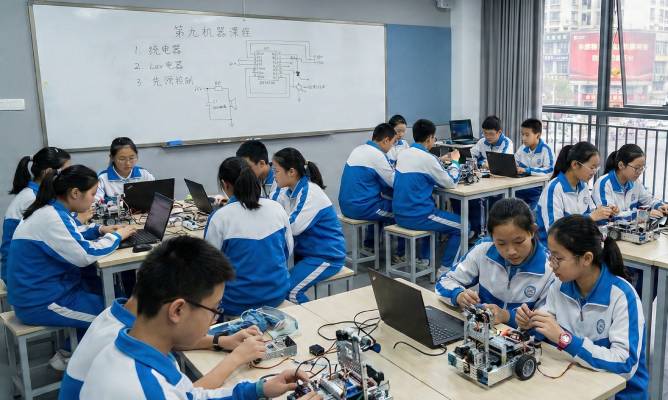
While the rest of the world debates the ethics of Artificial Intelligence, China has made a decisive move to ensure its next generation speaks the language of the future fluently.
In a sweeping educational reform that began rolling out in earnest this September, major Chinese cities have made AI education mandatory for students as young as six years old.
The policy marks a seismic shift in global education standards, moving AI from a niche elective for university students to a core subject alongside Mathematics and Literacy.
Leading the charge is Beijing, where the municipal education commission has mandated that all primary and secondary schools must now provide a minimum of 10 hours of AI coursework per academic year.
The directive is clear: AI is no longer just technology; it is a basic skill required for modern citizenship.
The curriculum is tiered and ambitious:
- Primary School (Grades 1-6): Students are introduced to “AI Awareness.” Instead of complex code, they use picture books and gamified apps to understand how robots “see” (computer vision) and “listen” (voice recognition).
- Middle School: Students transition to understanding the logic behind the magic, learning basic algorithms and data processing.
- High School: The focus shifts to “AI Innovation,” where students are expected to design simple intelligent systems and write code in languages like Python.
The “33-Volume” Strategy
This didn’t happen overnight. The rollout is backed by a massive logistical preparation, most notably the publication of a comprehensive 33-volume AI textbook series.
Developed by top researchers from the Chinese Academy of Sciences and corporate giants like SenseTime, the series covers a student’s entire academic lifecycle—from Kindergarten to High School. It creates a standardized pipeline of talent that no other nation currently matches.
“The goal is not just to produce elite computer scientists,” explains Dr. Li Zhang, an education policy analyst. “The goal is to create a massive workforce where every single worker, whether a doctor, a farmer, or an artist, understands how to work with AI tools.”
A Strategic Advantage
This “mass literacy” model stands in stark contrast to the approach in the West and parts of Africa, where AI education is often club-based, competitive, or reserved for top-tier universities.
By democratizing access to this knowledge, China is effectively trying to future-proof its economy. While other nations struggle with the “skills gap”—where graduates lack the tech skills employers need—China is attempting to close that gap before students even leave primary school.
For countries like Kenya, which has proven its elite capabilities by winning global competitions like the Huawei ICT Competition, China’s “mass adoption” model offers a sobering lesson: winning gold medals is excellent, but winning the future requires an army of tech-literate citizens.
READ ALSO: Huawei Bets Big on Kenya’s Green Energy Grid and AI Talent with New Strategic Blueprint







[…] Read Also: China Mandates Artificial Intelligence Classes for Six-Year-Olds […]