In a significant diplomatic and economic victory, Kenya has firmly re-established itself in the good graces of the United States, securing a massive $2.6 billion (approx. KSh 338 billion) financing package.
The deals, sealed during President William Ruto’s high-stakes visit to Washington, mark a pivotal shift in U.S. foreign aid policy under the Trump administration, moving away from traditional aid models toward direct government-to-government partnerships.
The funding is split into two landmark agreements: a $1.6 billion (KSh 208 billion) Health Cooperation Framework and a pioneering $1 billion (KSh 130 billion) Debt-for-Food Security Swap.
A New Era of Direct Health Funding
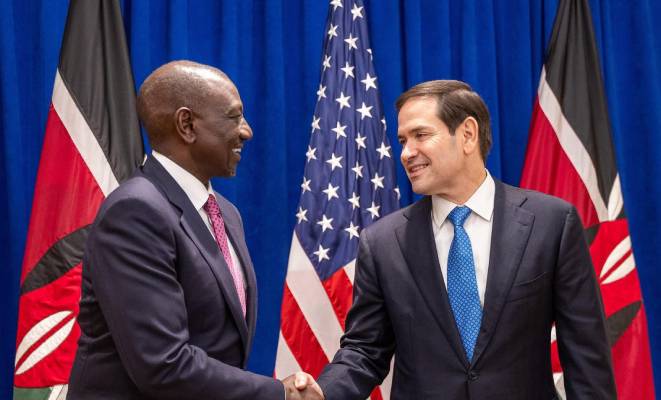
The crown jewel of the visit is the five-year, $1.6 billion health compact, signed by U.S. Secretary of State Marco Rubio and Prime Cabinet Secretary Musalia Mudavadi, with President Ruto witnessing the historic moment.
This agreement makes Kenya the first nation to pilot the new “America First Global Health Strategy,” which prioritizes direct funding to partner governments over international non-governmental organizations (NGOs).
“We are not going to spend millions of dollars funding the NGO industrial complex while close and important partners like Kenya have very little influence on how healthcare money is spent,” Secretary Rubio stated during the signing. “We’re not doing this anymore.”
Under this new Government-to-Government (G2G) model, funds will flow directly into Kenyan institutions such as the Social Health Authority (SHA) and the Kenya Medical Supplies Authority (KEMSA). This is a stark departure from the previous decades where USAID channeled billions through third-party implementers.
Key highlights of the Health Compact include:
- Direct Budget Support: Funds will modernize hospital equipment, boost disease surveillance, and support the digitization of health records.
- Domestic Commitment: In a show of “skin in the game,” Kenya has pledged to increase its own domestic health spending by $850 million over the next five years.
- Sustainability: The deal aims to make Kenya’s healthcare system self-sustaining, reducing long-term reliance on donor aid for HIV/AIDS, malaria, and tuberculosis programs.
President Ruto hailed the agreement as a vote of confidence in Kenya’s institutional integrity. “This gesture of goodwill by President Donald Trump, on behalf of the American taxpayers, reinforces our ongoing mobilization of domestic resources. I assure you that every shilling and dollar will be spent efficiently, effectively, and accountably,” Ruto said.
The $1 Billion Debt-for-Food Swap
In parallel to the health deal, Kenya successfully negotiated a $1 billion Debt-for-Food Security Swap with the U.S. International Development Finance Corporation (DFC).
This innovative financial mechanism is designed to offer fiscal breathing room to an administration grappling with a public debt load that touched 68.8% of GDP in the 2024/25 fiscal year.
How it works: The DFC will purchase a portion of Kenya’s expensive commercial debt, replacing it with lower-cost financing. The savings generated from this reduced interest burden—instead of returning to the general exchequer—will be ring-fenced for specific food security initiatives.
“We appreciate the DFC for agreeing to proceed with the $1 billion debt-for-food security swap to allow us to replace costly existing debt with lower-cost financing,” President Ruto announced.
The funds released by this swap are earmarked for:
- Agricultural Infrastructure: Investments in irrigation and storage to reduce post-harvest losses.
- Climate Resilience: Supporting farmers against climate shocks that have previously devastated maize and vegetable supplies.
- Nutrition Programs: Targeted interventions to combat malnutrition in arid and semi-arid lands.
Strategic Implications
These agreements signal a thaw in relations and a strategic realignment. By choosing Kenya as the launchpad for his administration’s new aid architecture, President Trump is positioning Nairobi as a key anchor for U.S. interests in East Africa.
For the Kenyan taxpayer, the deals offer a dual benefit: immediate support for a struggling healthcare system and a creative financial restructuring that eases the debt burden while addressing the critical issue of food security.